Put your form anywhere on your site.
One snippet, four styles. Embed it in the page, open it as a popup, slide it in from the side, or pin a tab to the edge.
1 →
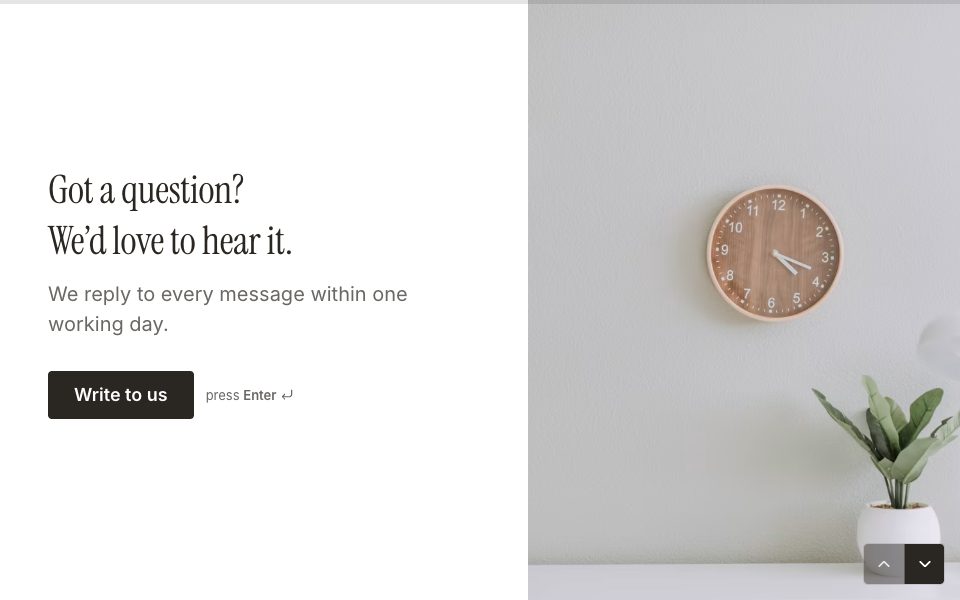
Thanks for reaching out. What’s your message about?
What you get
Inline
Sits in your page like it was built there, and resizes to fit each question.
Popup
Opens over the page from any button or link.
Slider and side tab
Slides in from the edge, or waits in a tab until someone’s ready.
Links and QR codes
Share a link, or download a QR code for posters, menus and packaging.
Your own domain
On Pro, share forms at forms.yourbrand.com instead of our address.
Fast and private
No tracking cookies on public forms, and bot protection that stays invisible for real people.
Set it up in three steps
- 1
Open a form’s Share tab and choose an embed style.
- 2
Copy the snippet.
- 3
Paste it into your site’s HTML or embed block. That’s it.
Free to start
Every plan includes this, Free too. One active form and 100 responses a month, no card needed.
Compare plansHow to embed a form on your website
Open your form’s Share tab, choose an embed style and copy the snippet. It has two parts: a placeholder that says which form to show and how, and one small script that does the work. Paste both where you want the form to appear. The script only needs to be on the page once, however many forms you embed.
<div data-forms-embed="your-form" data-mode="inline" data-height="560"></div>
<script src="https://formsai.dev/embed.js" async></script>
Replace your-form with your form’s address. For a popup, slider or side tab, change data-mode, and use data-label to set the button text.
Inline, popup, slider or side tab: which to choose
- Inline: the form sits in the page like any other section. Best on a contact page, a landing page or an article where the form is the point.
- Popup: the form opens in a centred window when someone clicks. Best behind a “Get a quote” or “Book a call” button, so the page stays clean.
- Slider: the form slides in from the right edge, leaving the page visible behind it. Good for feedback while people are still reading.
- Side tab: a small tab waits on the edge of every page until someone opens it. The classic “Feedback” tab.
- Any button: add data-forms-open="your-form" to a button or link you already have, and it opens the form as a popup.
Embedding in WordPress, Webflow and Framer
Any site builder that accepts custom HTML can show a Forms embed. In WordPress, add a Custom HTML block and paste the snippet. In Webflow, drag in a Code Embed element. In Framer, add an Embed component and paste the snippet as HTML. If your builder only accepts links, share the form’s link or a QR code instead.
Know where every response came from
The embed passes your page’s address parameters into the form. If someone lands on yourbrand.com/pricing?utm_source=newsletter and your form has a hidden field called utm_source, the response records “newsletter” without asking. Use the same trick for campaign names, referral codes or a customer ID you already know, and branch on them with logic.
Polite on your page
- The form loads in its own frame after your page, so it never holds up your content.
- An inline form doesn’t grab the keyboard or scroll the page until someone starts using it.
- Popups and sliders close with Escape or the close button, and focus returns to where it was.
- Animations are switched off for people who ask their device to reduce motion.
Embeds, answered
Does embedding cost extra?+
No. Every embed style is on every plan, Free included.
Will it work with my website builder?+
If your builder lets you paste HTML or an embed code, it works. That includes WordPress, Webflow and Framer.
Can I embed more than one form on a page?+
Yes. Each snippet points to its own form.
Do embeds slow my site down?+
The form loads in its own frame after your page, so it doesn’t hold up your content.


Try embeds free.
Every plan includes it. Make your first form in minutes, no card needed.
Start free