Questions
Quantitative questions: examples you can actually calculate with
A quantitative question asks for a number you can do real arithmetic with. This guide covers what counts, six examples you can copy, the questions that look like numbers but aren't, and how to ask one in Forms.
What counts as quantitative
Portland Community College's Math in Society text, in its chapter on describing data, puts it plainly: "Quantitative data are responses that are numerical in nature and with which we can perform meaningful calculations." Its example is the number of movies you have seen in a movie theater in the past 12 months.
Categorical data classifies people instead. Ask for someone's favorite movie and you can count how many people gave each answer, but you can't calculate with a film title.
A number on its own isn't enough. A ZIP code is a number, and the same text calls it categorical, because no calculation with it means anything. Ratings work the same way: a movie rated 4 is not necessarily twice as good as one rated 2. An average such as 3.7 stars can still tell you something useful.
Six quantitative question examples
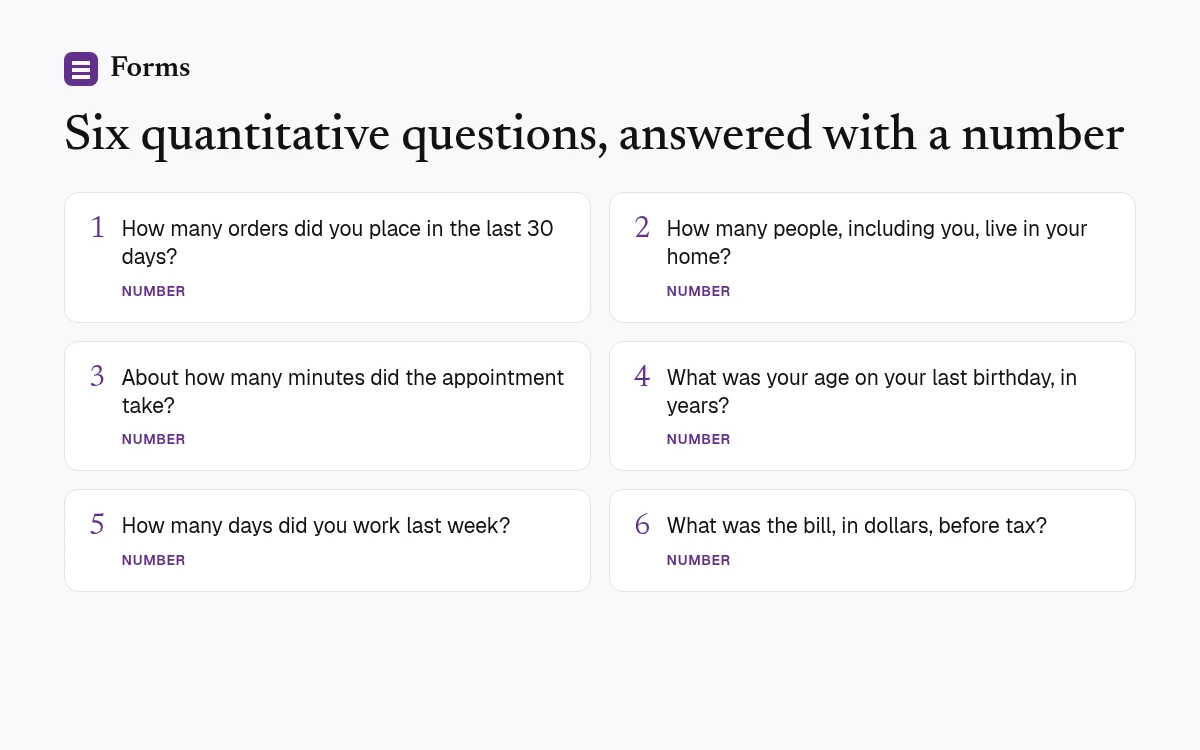
Each one is a Number question, and each names its unit and its period, so everyone answers the same thing.
- How many orders did you place in the last 30 days?
- How many people, including you, live in your home?
- About how many minutes did the appointment take?
- What was your age on your last birthday, in years?
- How many days did you work last week?
- What was the bill, in dollars, before tax?
Question 2 also appears on the customer needs survey, asked as a Dropdown. A dropdown of household sizes is categorical. A Number question for the same fact is quantitative.
Questions that look quantitative and aren't
- "Which plan are you on?" Multiple choice. You can count how many people chose each plan, but the plan itself is a category.
- "Have you bought from us in the last 12 months?" A Yes/No question, one of the dichotomous questions. Report the share who said yes. The answer isn't a quantity.
- "How would you rate your experience?" A Rating on the customer satisfaction survey. It's an ordered category. It isn't a Likert item either: Likert scale questions ask how much someone agrees with a statement.
- "How often do you buy new shoes?" An Opinion scale on the market research survey. Its steps are labels, not a count. If you need the count, ask it like question 1: how many times, in a named period.
- "How likely are you to recommend us?", from 0 to 10. That's Net Promoter Score. Forms calculates it as the percentage of promoters (9 to 10) minus the percentage of detractors (0 to 6), not as the average score. See the NPS survey template.
- A ranking. First place tells you order, not a quantity.
Closed-ended is a different cut
Closed-ended questions ask people to pick from answers you set. Quantitative questions ask for a number you can calculate with. The two don't line up: a multiple choice question about someone's favorite color is closed and categorical, while a Number question is quantitative and has no list at all.
Ask it in Forms
Use the Number type. It's one of all 25 question types, and all of them are on every plan. Put the unit and the period in the question, as in the examples above.
Set a range when a wild value would be nonsense, so numbers stay within the range you set. Days worked in a week, for example, can't go above seven.
Results shows a chart for each question, with averages and NPS; see form results and analytics. For NPS, Results does the calculation for you. You can also send responses to Google Sheets on every plan.
Free gives you 3 active forms and 100 responses a month. Pro is $12/mo billed yearly. The AI form builder is Pro only. See Forms pricing, or types of survey questions for the other formats.
Quantitative questions, answered
What is a quantitative survey question?
It asks for a number you can calculate with, such as a count, an amount, or an age in years. "How many orders did you place in the last 30 days?" is one. "Which plan are you on?" is not. You can count those answers, but the answer itself is a category.
What is an example of a quantitative question?
"About how many minutes did the appointment take?" The person types a number. In Forms that is the Number question type. "How would you rate your experience?" is a rating. People often average ratings, and a rating of 4 is not twice a rating of 2.
Are quantitative questions the same as closed-ended questions?
No. Closed-ended means the person picks from answers you wrote. Quantitative means the answer is a number you can calculate with. A yes/no question is closed-ended and not quantitative. A question that asks for a count is quantitative, and it does not need a list of options.
Is a Likert scale quantitative?
A labelled agreement scale is an ordered category. The steps are not a unit like minutes or dollars, and one step is not proven equal to the next. Forms has an Opinion scale for that kind of statement and a Rating for a score. It does not have a question type named Likert, and it does not publish a summed Likert score.
Can I collect quantitative answers for free in Forms?
Yes. The Number type is one of the 25 question types on every plan, including Free. Free is 3 active forms and 100 responses a month. You can set a range so a number stays inside bounds you choose. Pro is $12/mo billed yearly.
Start from the customer needs survey See Free vs Pro
New here? Start at Forms.