Types of questions in a questionnaire, with examples
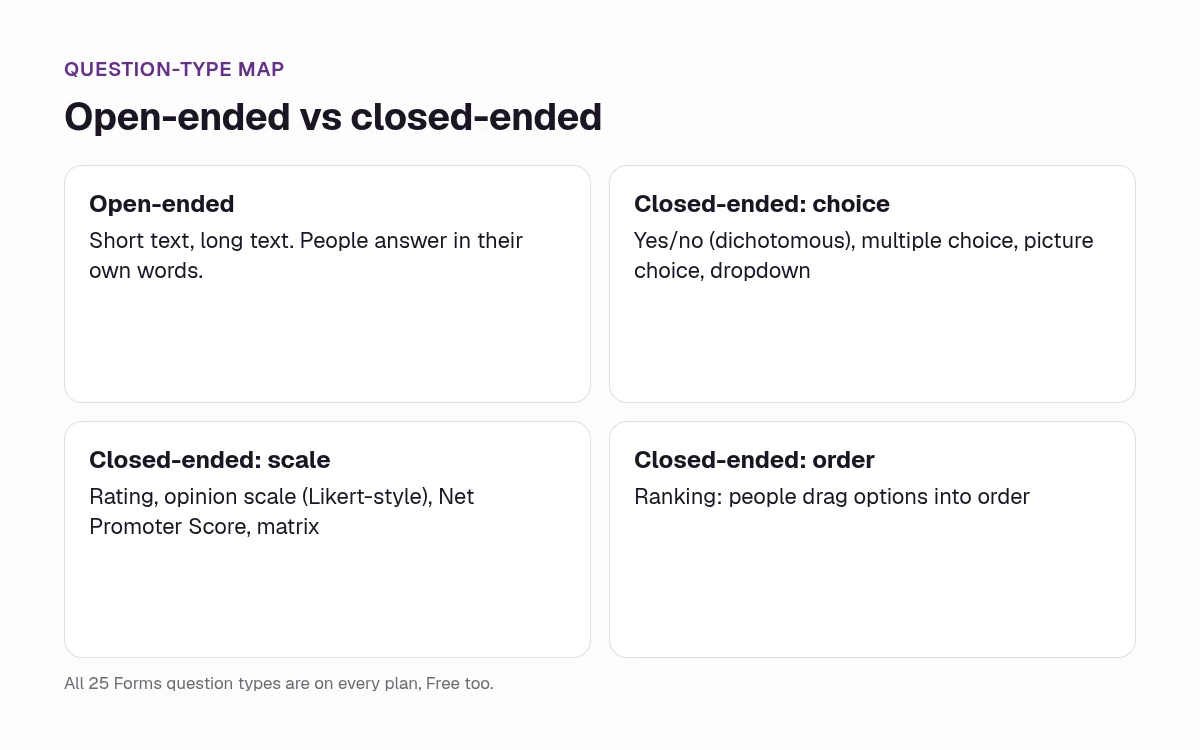
Every question in a questionnaire either asks people to answer in their own words or asks them to pick from answers you wrote. The types below are variations on those two. For each one you'll find what it is, an example, when to use it and the Forms question type that does the job.
The product list is on all 25 question types in Forms. Every one of them is on the Free plan.
Open-ended vs closed-ended questions
An open-ended question asks people to answer in their own words. A closed-ended question asks them to choose from a list you set. Pew Research Center's guide to writing survey questions adds two rules for closed lists: include all the reasonable answers, and don't let the options overlap.
The choice changes the answers you get. After the 2008 US presidential election, Pew asked people which one issue mattered most to them in deciding how they voted for president. When the economy was offered in a closed list, 58% chose it. When people answered in their own words, 35% named the economy. On the closed version, 8% gave an answer outside the five options they were offered. On the open version, 43% gave an answer that wasn't in that list.
Closed questions are easier to count. They also steer people toward the options you thought of. Here is one topic asked both ways:
- Open: "What should we change about the checkout?"
- Closed: "Which part of checkout was hardest?", with a short list and room for an answer the list missed.
The main question types
Dichotomous
A dichotomous question has exactly two options. Merriam-Webster defines dichotomous as dividing into two contradictory or contrasting parts. The word comes from the Greek dichótomos, "cut in half".
The usual pairs are yes/no and true/false. Agree/disagree is also two options, but Pew warns that agree/disagree items draw an acquiescence bias: some people, especially those with less education, tend to agree. When you can, offer a choice between two real alternatives instead.
Examples: "Did you attend the last class?" and "Have you bought from us in the last 12 months?", each answered Yes or No.
Use one for a fact, a screen or a branch, not when you need degree. Add "not sure" and it has three options, so it's no longer dichotomous. More on dichotomous questions, with 30 examples.
In Forms: Yes/No, on every plan. The trivia quiz template uses it for "True or false: this opera house is in Sydney".
Multiple choice
A multiple choice question asks for one answer from a list of more than two. Pew advises keeping unordered lists reasonably short and, in a self-administered survey, shuffling their order, because people tend to pick options near the top. Don't shuffle a list that has an order, such as poor to excellent: the order is the information.
Examples: "Which session did you attend?" and "Where do you usually buy shoes?", which the market research template already asks.
In Forms: Multiple choice, for one answer from a short list. A long list, such as countries, is a Dropdown. Options shown as pictures are Picture choice.
Multiple select
A multiple select question, often written "select all that apply", lets people tick every option that fits. Pew compared it with asking a separate yes/no question about each item, in a 2019 study of 4,581 US adults surveyed from 30 July to 12 August 2018. The yes/no version, which Pew calls forced choice, produced higher estimates, and in that study more accurate ones.
On forced choice, 19% said they had personally been denied coverage by a health insurance company, against 13% on select-all. For someone in their immediate family losing a job and struggling to find another, it was 63% against 51%. On average, forced-choice estimates ran 8 percentage points higher. Pew has since adopted a policy of using forced choice instead of select-all in its online surveys whenever possible. The rank order of the items was often the same, so a list will do if you only need to know which item comes first.
In Forms: there's no select-all question type. Checkbox is a consent tick, for safeguarding or data consent. Ask a Yes/No about each item instead, the format Pew prefers.
Rating scale
A rating asks for a score on one thing, as stars or a number, without a full attitude statement. Use it when you want a quick score.
Examples: "How would you rate your experience?" on the customer satisfaction template, and "How would you rate the instructor?" on the course evaluation template.
In Forms: Rating, for star or number ratings. Results shows charts and averages; see form analytics.
Likert scale
The APA Dictionary of Psychology defines a Likert scale as a direct attitude measure made of statements that reflect a strong positive or negative evaluation. People pick the option closest to their view. Five-point versions are common, such as strongly disagree, disagree, neither disagree nor agree, agree and strongly agree, and a neutral middle may or may not be included. The ratings are summed into a total attitude score. One statement in that format is a Likert-type item, and the summed set is the scale.
The scale is named after Rensis Likert (1903 to 1981). His 1932 monograph, Archives of Psychology No. 140, used the labels strongly approve, approve, undecided, disapprove and strongly disapprove.
Example of a Likert-type item: "The course increased my interest in the subject." The course evaluation template asks it on an Opinion scale, alongside two more statements of the same type. Use one when you need degree of agreement, not a yes or no.
In Forms: an Opinion scale, with labels for agreement, for one statement, or a Matrix when several statements share one scale. Forms does not name a question type Likert, and it does not publish a summed Likert score. Net Promoter Score isn't a Likert scale either: it's a 0 to 10 recommend question, below.
Ranking
A ranking question asks people to put options in order. You learn their priorities, not how much they like the first one.
Example: "Put these in the order you would fix them: speed, price, support."
In Forms: Ranking, where people drag options into order.
Net Promoter Score
Net Promoter Score® asks how likely someone is to recommend you, from 0 to 10. In Forms, 9 or 10 is a promoter, 7 or 8 a passive and 0 to 6 a detractor. The score is the percentage of promoters minus the percentage of detractors, so it runs from -100 to +100. With 60% promoters and 15% detractors, the score is +45.
In Forms: Net Promoter Score, and Results calculates the score for you. The NPS template is three questions, about 1 minute: the 0 to 10 question, then a long-text follow-up that changes with the score.
Open text
Open text is the open-ended half of the first section, as a type of its own. Use it for the reason behind a score, and keep these few: long text takes people the most effort.
Example: the customer satisfaction template ends with "Any other feedback before you go?" as optional long text.
In Forms: Long text for a sentence or more, Short text for a name or a few words.
Demographic
Demographic questions ask about things like age, education, job or income. They aren't a format of their own, and Forms has no question type named Demographic. Age can be a Number or a Multiple choice band. Education or job can be a Dropdown or Multiple choice. Income bands, if you ask them, are Multiple choice.
Pew advises against opening a survey with questions like income, education or age, unless you need them to decide who continues.
Matrix
A matrix asks several items on one shared scale. Forms' own advice: to rate several things on the same scale, use a matrix instead of five separate questions.
Use one for three or four Likert-type statements that share the same labels. Don't use it as a select-all grid.
In Forms: Matrix.
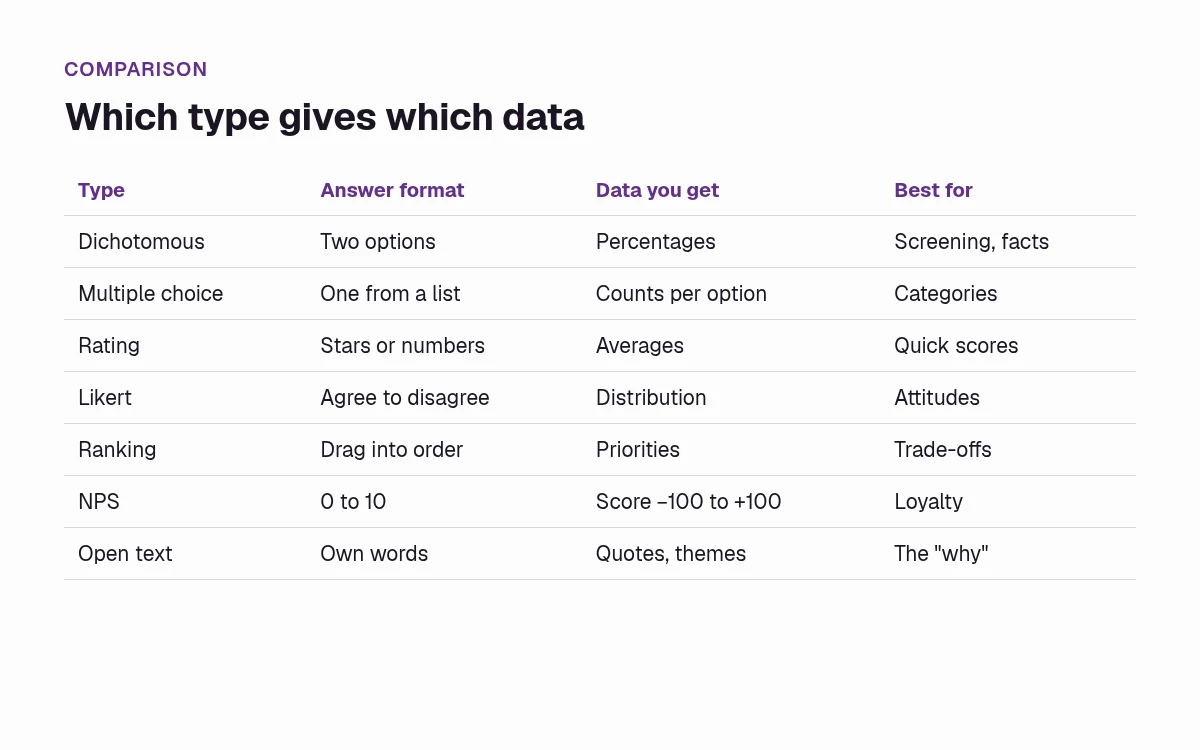
Question types compared
| Type | Answer format | Data you get | Best for | Forms question type |
|---|---|---|---|---|
| Dichotomous | Two options | The share for each answer | A fact, a screen or a branch | Yes/No |
| Multiple choice | One option from a list | Counts per option | One category | Multiple choice, Dropdown or Picture choice |
| Multiple select | Every option that applies | Counts per option | Which item comes first | No select-all type: a Yes/No for each item |
| Rating scale | Stars or a number | Averages | A quick score on one thing | Rating |
| Likert scale | Agreement with statements | A spread of agreement | Degree of agreement | Opinion scale, or Matrix for several statements |
| Ranking | Options put in order | Priorities | Order | Ranking |
| Net Promoter Score | 0 to 10 | A score from -100 to +100 | Whether people would recommend you | Net Promoter Score |
| Open text | Their own words | Words to read | The reason behind a score | Long text or Short text |
| Demographic | Age, education, job or income | Groups to compare | Screening and comparing groups | Number, Multiple choice or Dropdown |
| Matrix | Several items on one scale | A rating for each item | Statements that share labels | Matrix |
How to choose the right question type
Start from the data you need:
- Their words: Long text.
- A fact or a branch: Yes/No.
- One category: Multiple choice.
- A rate for each item in a list: a Yes/No on each item, not a select-all list.
- A quick score: Rating.
- Agreement with a statement: Opinion scale. For several statements, Matrix.
- Order: Ranking.
- Whether they'd recommend you: Net Promoter Score.
Whatever the type, AAPOR's best practices apply: ask about one thing at a time, use short plain words, avoid language that pushes people toward an answer, and give options that don't overlap and that cover the reasonable answers. Sometimes that means a "don't know" or "does not apply" option.
Common mistakes
- Leading wording. AAPOR advises against wording that pushes people toward one answer, or that shows only one side.
- Double-barreled questions. Pew's example asks about confidence in a president to handle domestic and foreign policy, which is two questions in one. Forms makes the same point on its question types page: "How was the food and service?" is two questions.
- A closed list with no way out. Closed options should include the reasonable answers, and sometimes a "does not apply". If you need the answer your list missed, add an option for it and a Long text follow-up that conditional logic shows only to the people who pick it.
Build your questionnaire in Forms
All 25 question types are on every plan, Free included. Free is 3 active forms and 100 responses a month. Pro is $12/mo billed yearly, with unlimited responses under the fair use policy and one custom domain. The AI form builder is Pro only. See Forms pricing.
Logic is on every plan too, so a follow-up shows only when it applies. Responses can go to Google Sheets on every plan.
These templates already mix several types:
- The customer satisfaction template: short text, picture choice, rating, opinion scale, multiple choice, Net Promoter Score and long text.
- The course evaluation template: a dropdown, three opinion scales, a rating and two long texts.
- The employee pulse template: a rating, two opinion scales, a Yes/No and a long text.
Browse free form templates, the feedback survey templates or the quiz and poll templates, including the quick poll template. Choosing a tool? Read Forms vs SurveyMonkey.
Questionnaire questions, answered
What are the main types of questions in a questionnaire?
They split into open-ended questions, which people answer in their own words, and closed-ended questions, which people pick from answers you set. Closed types include dichotomous (exactly two options), multiple choice (one option from a list), multiple select (every option that applies), rating scales, Likert scales, ranking and Net Promoter Score. A matrix asks several items on one shared scale.
What's the difference between open-ended and closed-ended questions?
An open-ended question asks for an answer in the respondent's own words. A closed-ended question asks them to choose from a list. In a Pew Research Center comparison after the 2008 election, offering "the economy" in a closed list raised that answer from 35% (people who volunteered it) to 58% (people who chose it). Closed lists are easier to count. They also steer people toward the options you remembered to include.
What is a dichotomous question?
A dichotomous question has exactly two answers, such as yes and no, or true and false. It is closed-ended. It works for a fact or a screening question. It cannot show degree. If you add a third option such as "not sure", it is no longer dichotomous.
When should I use a Likert scale vs a rating scale?
Use a rating when you want a quick score on one thing, such as stars for an instructor. Use a Likert-type item when you want agreement with a statement, such as "The course increased my interest in the subject." A Likert scale, in the APA's definition, is a set of those items whose ratings are summed. Forms has a Rating type and an Opinion scale for a labelled agreement item. It does not publish a summed Likert score, and it does not name a question type Likert.
Can I use all these question types for free in Forms?
Yes. All 25 question types are on every plan, Free included. The Free plan is 3 active forms and 100 responses a month, with no card needed. Pro is $12/mo billed yearly, with unlimited responses under the fair use policy and one custom domain. There is no select-all type and no type named Likert or Demographic. The guide above names the type to use instead.
Browse free templates See Free vs Pro
New here? Start at Forms.