Dichotomous questions: definition and examples
A dichotomous question gives people exactly two answers to choose from. This guide defines the term, lists 30 examples you can adapt, and shows when two answers are enough and when they aren't.
What is a dichotomous question?
Merriam-Webster defines dichotomous as dividing into two contradictory or contrasting parts. The word comes from Late Latin dichotomos, from the Greek dichótomos, "cut in half, divided equally", built from dicho- and the base of témnein, "to cut". Its first known use as an adjective is from 1752.
In a questionnaire, that means two options and no middle. Yes/no and true/false are the clean pairs. Agree/disagree and fair/unfair are two options as well, so they're dichotomous too, but they're weaker for attitudes: Pew Research Center documents an acquiescence bias on agree/disagree items, where some respondents tend to agree.
A dichotomous question is closed-ended: people pick from options you set. Pew's guide to writing survey questions says closed options should be exhaustive and mutually exclusive. Two options fail that test when the real answer is neither of them.
30 dichotomous question examples
Each question is answered yes or no, except number 15, which is true or false. They're written for this page, so adapt the wording to your own form.
Customer feedback
- Have you bought from us in the last 12 months?
- Did your order arrive on the day we promised?
- Was your question resolved in that conversation?
- Would you buy from us again?
- Did you look at the product page before you bought?
Employee and HR
- Do you have the tools you need to do your work this week?
- Did you meet with your manager in the last month?
- Have you completed this year's required training?
- Are you able to take the time off you have earned?
- Would you like a conversation about your workload?
Education
- Did you attend the last class?
- Have you finished the assigned reading?
- Was the homework posted before the class?
- Do you want a review session before the test?
- True or false: the office hour is on Thursday.
Clinic admin
- Is this your first visit to this clinic?
- Do you have your insurance card with you today?
- Would you like a reminder before your appointment?
- Is the name on the booking the patient's name?
- May we email the receipt to you?
Events
- Will you attend in person?
- Are you bringing a guest?
- Do you need a parking spot?
- Have you been to this event before?
- Will you need a printed name badge?
Screening and eligibility
- Are you 18 or older?
- Do you live in the United States?
- Have you used a product like this before?
- Are you the person who decides on this purchase?
- May we email you about your answers?
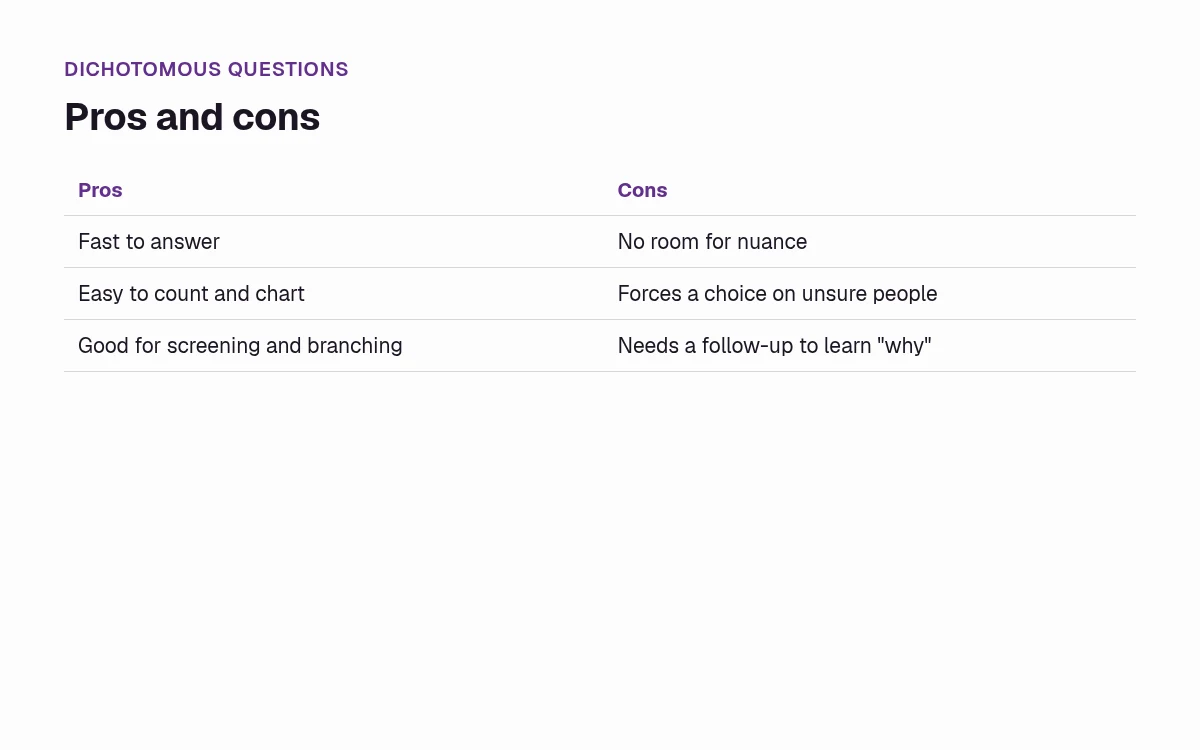
Pros and cons
| Pros | Two answers are fast. You can report the share who said yes. A Yes/No is a clean branch into a follow-up. |
|---|---|
| Cons | There is no room for degree. Agree/disagree pulls some people toward agree (Pew). If neither option is true, the answer is forced and the count is wrong. |
When to use one, and when not to
Use a dichotomous question for a fact, a screen or a gate, such as number 26 above. Don't use it for satisfaction, for how strongly someone agrees, or for how often something happens. For those, pick another type:
- Degree of agreement: a Likert-type item. In Forms, that's an Opinion scale, or a Matrix when several statements share the same labels.
- One category from three or more: Multiple choice, for one answer from a short list.
- A recommend score: Net Promoter Score, from 0 to 10, which Forms calculates. It isn't dichotomous.
The guide to types of questions in a questionnaire compares them all.
How to write a good dichotomous question
- Ask one thing. "Did you like the food and the service?" is two questions. Pew's own illustration asks about confidence in a president on domestic and foreign policy. Forms' question types page makes the same point with "How was the food and service?"
- Name the period. "Have you bought from us?" is vaguer than number 1, which says "in the last 12 months".
- Make both answers possible. Don't write a yes/no question whose "no" can't be true.
- Don't lead. "Don't you agree that our service is excellent?" isn't a question to put in front of people. AAPOR's best practices say to avoid wording that pushes people toward an answer.
- Decide on "not sure" on purpose. AAPOR lists a "don't know" or "does not apply" option as sometimes the right research choice. The moment you add one, the question has three options and is no longer dichotomous.
If you need to keep two options, put the instruction under the question. For number 1, that looks like this:
Have you bought from us in the last 12 months?
Choose one answer. If you are not sure, choose No.
That keeps the question at two answers, so don't add a separate Not sure button as well. If you're building the form in your own HTML, the W3C's tutorial on grouping form controls shows how to wrap a group of radio buttons in a fieldset with a legend.
Add a yes/no question in Forms
Forms has a Yes/No question type, on every plan, Free included. It's one of all 25 question types, and all 25 are on Free.
There's no dichotomous template, so there's no one-click version of this page. A close start is the employee pulse template, which has one Yes/No among five questions and takes about 2 minutes, or the event feedback template, which has one Yes/No. Every template is free: browse free form templates, the feedback survey templates or the quick poll template.
To find out why someone said No, branch on a yes/no answer with conditional logic, which is on every plan. Open the Logic tab, add a rule, then pick the condition and the action: if the answer is No, show one Long text question for the reason. A rule can combine up to 30 conditions with "and" or "or".
Results shows a chart for each question, and a summary with charts and averages; see form analytics. For a yes/no question, report the share who said yes.
Free gives you 3 active forms and 100 responses a month. Pro is $12/mo billed yearly, with unlimited responses under the fair use policy and one custom domain. The AI form builder is Pro only. See Forms pricing, or compare Forms vs Google Forms.
Dichotomous questions, answered
What is a dichotomous question?
A dichotomous question has exactly two answers. The word means dividing into two parts. In a survey those answers are usually yes and no, or true and false. Agree/disagree and fair/unfair are also two-option questions. The respondent picks one, and there is no middle.
Is a yes/no question always dichotomous?
Yes, when yes and no are the only two answers. If you add a third option, such as "not sure" or "does not apply", it is a closed question with three answers, not a dichotomous question.
What are the advantages and disadvantages of dichotomous questions?
They are fast to answer and easy to count, and a yes or no is a clean way to decide which question comes next. They cannot show degree. Agree/disagree wording also tends to draw agreement from some respondents, which Pew Research Center describes as acquiescence bias. If neither option is really true, people are forced into a bad answer.
Is a dichotomous question open or closed-ended?
Closed-ended. An open-ended question asks people to answer in their own words. A dichotomous question asks them to pick one of two options you set.
Can a dichotomous question have a "don't know" option?
Not if you still want it to be dichotomous. Two options is the definition. AAPOR says a "don't know" or "does not apply" option is sometimes the right choice, and adding it means the question is no longer dichotomous. If you must keep two buttons, put the instruction in the question text, for example "If you are not sure, choose No."
How do I analyze dichotomous survey data?
Count each answer and report the share who said yes and the share who said no. In Forms, Results shows a chart for each question. That is the whole analysis for a single yes/no item. If you need the reason, add one open follow-up and read those answers. Do not treat a yes/no as a score out of 10.
Start from the employee pulse template See Free vs Pro
New here? Start at Forms.