Questions
Closed-ended questions: examples and a sample questionnaire
A closed-ended question gives people a set of answers to choose from. People also search for it as "close ended", which means the same thing. This guide covers what makes a question closed-ended, a short sample questionnaire you can copy, more examples by type, how to write them, and how to build one in Forms.
What a closed-ended question is
Pew Research Center's guide to writing survey questions draws the line simply: an open-ended question asks people to answer in their own words, and a closed-ended question asks them to choose from a list of answers. Pew adds that the options should be exhaustive and mutually exclusive, so every reasonable answer is covered and no two overlap.
AAPOR's best practices for survey research put it this way: "Response options for closed-ended questions should be chosen with care. They should be mutually exclusive, include all reasonable options ..., and be in a logical order." In some cases, a "don't know" or "does not apply" option is one of those reasonable options.
The format changes the answers. After the 2008 US presidential election, Pew asked people which one issue mattered most to them in deciding how they voted. When the economy was offered in a closed list, 58% chose it. When people answered in their own words, 35% named the economy. On the closed version, 8% gave an answer outside the list. On the open version, 43% gave an answer that wasn't in that list.
So closed questions are easier to count, and they also steer people toward the options you wrote. For how they sit beside the other formats, see types of questions in a questionnaire.
A sample closed-ended questionnaire
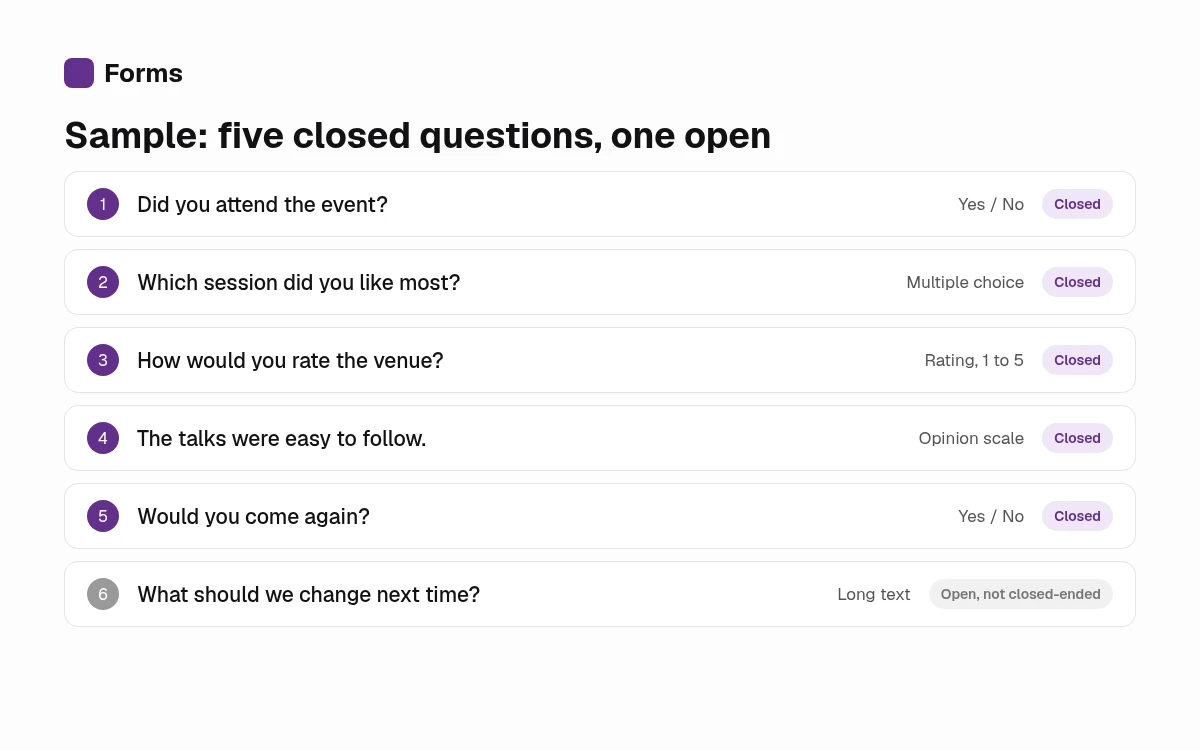
Here is a six-question event feedback form. Questions 1 to 5 are closed-ended. Question 6 is open, so you can read the reason behind the scores. It's an example to copy, not a template in the gallery.
| # | Question | Forms question type | Closed or open |
|---|---|---|---|
| 1 | Did you attend the event? | Yes/No | Closed |
| 2 | Which session did you like most? | Multiple choice | Closed |
| 3 | How would you rate the venue? | Rating, 1 to 5 | Closed |
| 4 | The talks were easy to follow. | Opinion scale | Closed |
| 5 | Would you come again? | Yes/No | Closed |
| 6 | What should we change next time? | Long text | Open, not closed-ended |
More closed-ended examples, by type
Yes/no
Two answers and no middle make one of the dichotomous questions. The trivia quiz template asks "True or false: this opera house is in Sydney." on the Yes/No type, with True and False as the answers.
Multiple choice
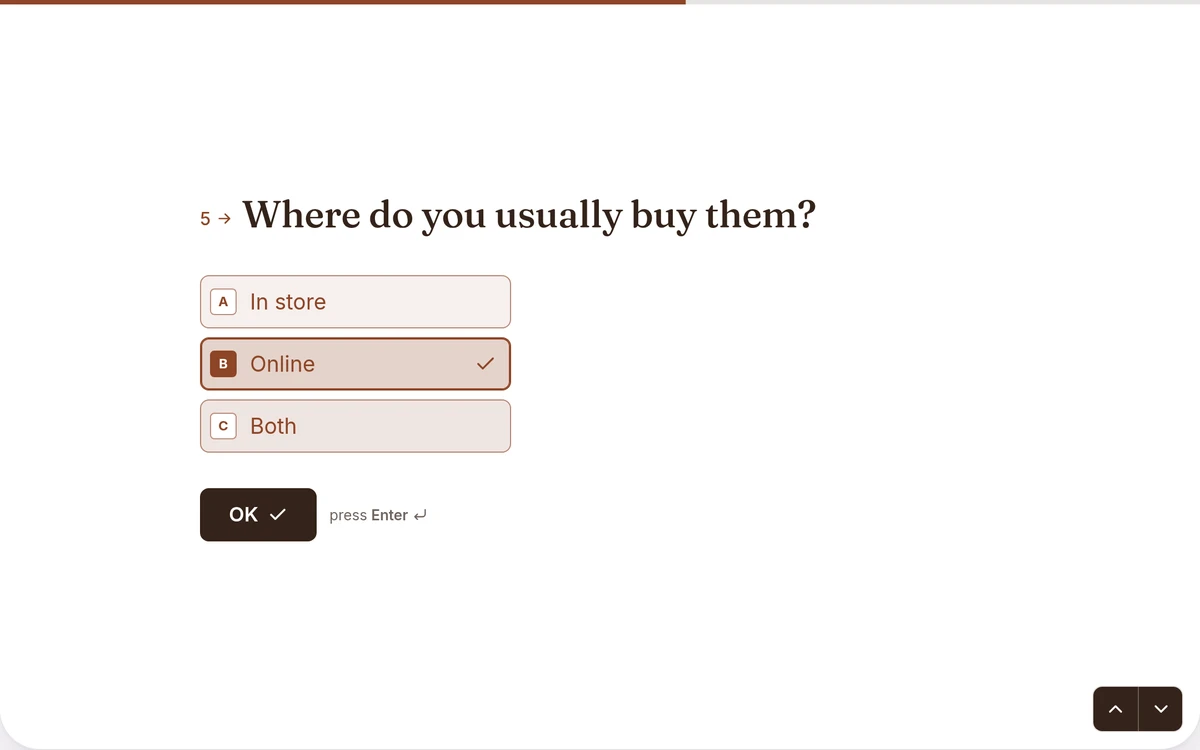
One answer from a short list. The market research survey asks "Where do you usually buy them?" with three answers: in store, online or both. In Forms, Multiple choice records one answer. A question where people tick every option that applies is a different thing: see multiple selection questions.
Rating
A score on one thing. The customer satisfaction survey asks "How would you rate your experience?" as a Rating.
Agreement scale
A statement people agree or disagree with, on labelled steps. The course evaluation template asks "The course increased my interest in the subject." on an Opinion scale. There's more on these in Likert scale questions.
Net Promoter Score
How likely someone is to recommend you, from 0 to 10. See the NPS survey template.
How to write a closed-ended question
- Ask one thing. Pew warns against double-barreled questions, and the Forms question types page makes the same point: "How was the food and service?" is two questions.
- Name the period. "In the last 12 months" gives everyone the same window to answer about.
- Don't lead. AAPOR advises against wording that pushes people toward a certain answer.
- Mind the order. Pew notes that in a self-administered survey, people tend to pick options near the top of a list. AAPOR says options should be in a logical order, and that in some circumstances they should be rotated. A scale with an order, such as poor to excellent, keeps it.
- Put personal questions later. Pew advises against opening a survey with personal questions such as demographics.
Build it in Forms
All 25 question types are on every plan, Free included, so you can build the whole sample on Free. Yes/No, Multiple choice, Rating, Opinion scale and Long text are all among all 25 question types.
To ask question 6 only when it's useful, use conditional logic, which is also on every plan: for example, show the Long text question only when the venue rating is low. A rule can combine up to 30 conditions with "and" or "or".
A few things to know about the closed types in Forms. Multiple choice takes one answer, and there's no select-all type. Checkbox is a consent tick, not a list of answers. The Opinion scale has labels for agreement.
There's no closed-ended template in the gallery. The customer satisfaction survey is a start: it mixes several closed types with an open long-text question near the end. Browse more free form templates.
Free gives you 3 active forms and 100 responses a month. Pro is $12/mo billed yearly, with unlimited responses under the fair use policy and one custom domain. The AI form builder is Pro only. See Forms pricing.
Closed-ended questions, answered
What is a closed-ended question?
A closed-ended question asks people to choose from answers you set, instead of writing their own. Yes/no, multiple choice, rating and agreement-scale questions are all closed-ended. Good closed questions cover every reasonable answer, don't overlap, and list the options in a logical order, so the answers are easy to count and compare.
What is an example of a closed-ended question?
"Did you attend the event?" with Yes and No is a closed-ended question. So is "Which session did you like most?" with a list of sessions, or "How would you rate the venue?" on a 1 to 5 rating. Each one asks people to pick an answer you wrote, not to type their own.
What is the difference between open-ended and closed-ended questions?
An open-ended question asks for an answer in the respondent's own words. A closed-ended question asks them to choose from a list. In a Pew Research Center comparison after the 2008 election, 58% chose the economy from a closed list, while 35% named it in their own words. Closed lists are easier to count, but they steer answers.
Can a questionnaire be all closed-ended questions?
Yes, and many are. Closed-ended questions are quick to answer and easy to count. The catch is that they tell you which answer people picked, not why. One open question, such as "What should we change next time?", often gives you the reason behind the scores. In Forms, logic can show it only when it's needed.
Is a yes/no question closed-ended?
Yes. A yes/no question asks people to pick one of two answers you set, so it is closed-ended. With only those two answers, it is also one of the dichotomous questions. In Forms, use the Yes/No type, which is on every plan, Free included.
Start from the customer satisfaction survey See Free vs Pro
New here? Start at Forms.