Questions
Likert scale questions: examples and how to write them
A Likert scale question asks how strongly someone agrees with a statement. This guide covers what the term means, how one Likert item differs from a full scale, eight examples, how to write good statements, and how to ask them in Forms.
What a Likert scale is
The APA Dictionary of Psychology defines a Likert scale as a direct attitude measure made of statements that reflect strong positive or negative evaluations of something. Five-point scales are common, and a neutral middle point may or may not be included. A typical set of choices is strongly disagree, disagree, neither disagree nor agree, agree and strongly agree.
People choose the option closest to their view, and the ratings are summed into a total attitude score. That's why APA also calls it the Likert summated rating procedure.
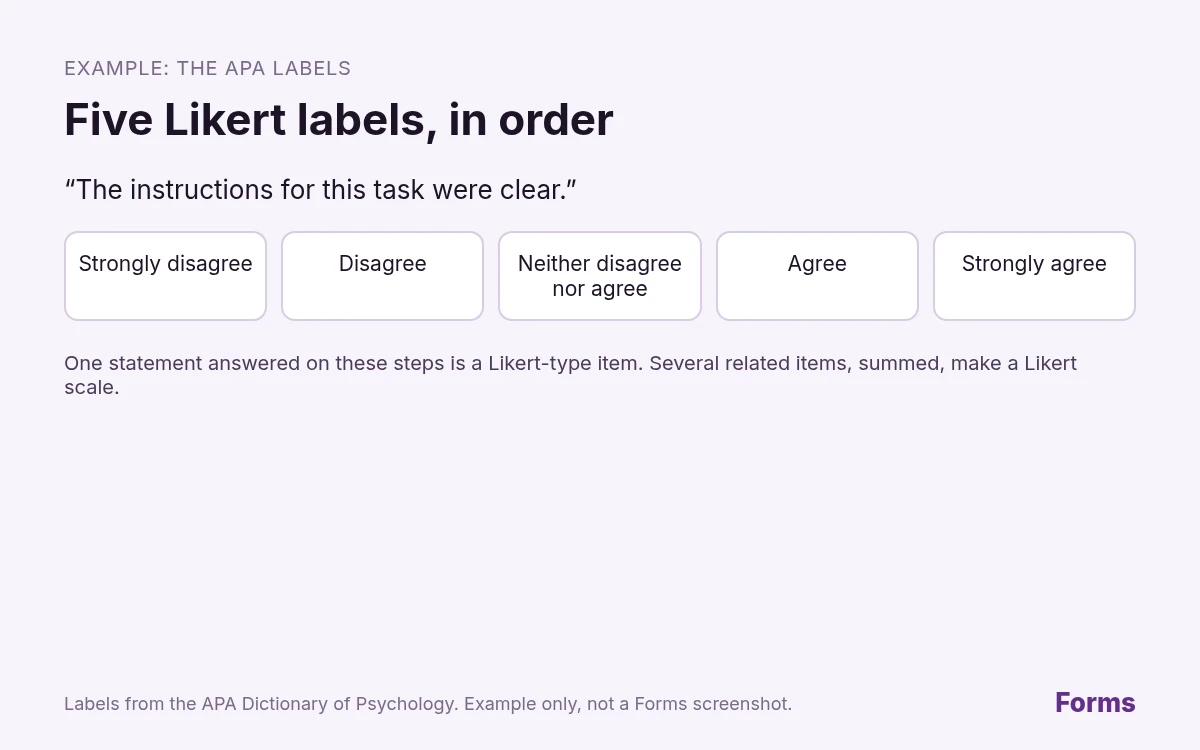
The scale is named after the US psychologist Rensis Likert (1903 to 1981). In his 1932 monograph, A Technique for the Measurement of Attitudes (Archives of Psychology No. 140), the main survey's statements were answered strongly approve, approve, undecided, disapprove or strongly disapprove, scored 1 to 5 with undecided as 3. The same study also asked questions answered Yes, a question mark or No, which is a different format from the five-step statements.
Likert-type item vs Likert scale
One statement answered on labelled steps is a Likert-type item. A Likert scale is a set of items about the same attitude, with each person's ratings added up into one score.
The difference matters when you report results. In Forms, Results shows a chart for each question, along with NPS and averages; see form analytics. An average for one statement is useful, but it isn't a summed Likert score. If your study needs that total, decide how you'll score and add up the items before you collect answers.
Likert scale question examples
The first three are the statements on the Forms course evaluation template, which asks them on an Opinion scale. The other five are written for this page. Each is answered from strongly disagree to strongly agree.
- The course increased my interest in the subject.
- The workload was right for the goals of the course.
- I feel more confident using these skills at work.
- The instructions for this task were clear.
- My manager gives me useful feedback.
- The checkout was easy to use.
- Our city should build more protected bike lanes.
- I have enough time in the week to finish my work.
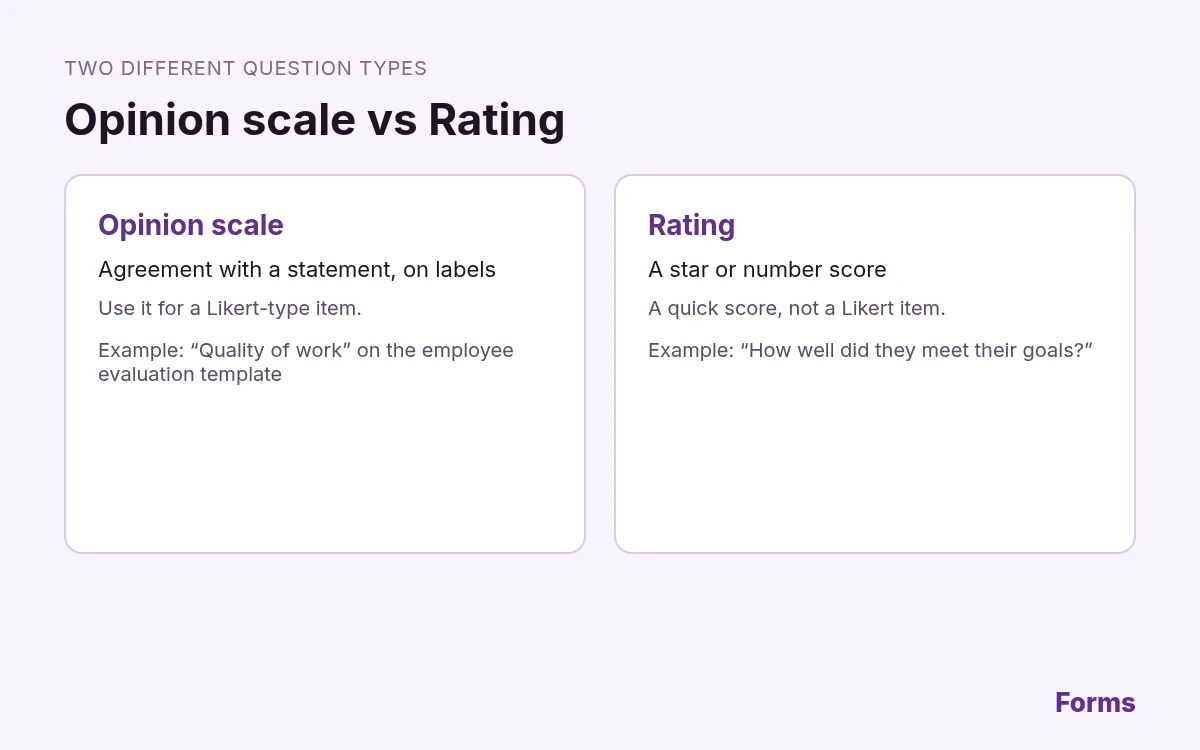
Not every scale on a form is a Likert item. The employee evaluation template asks about quality of work on an Opinion scale, then asks how well the person met their goals on a Rating: a score, not agreement with a statement.
How to write Likert questions
Likert's 1932 monograph sets out rules for the statements themselves:
- Ask about what should happen, not a fact. Likert wanted a "judgment of value" rather than a "judgment of fact", and suggested wording built on "should", as in example 7.
- Keep it clear and simple. Use plain words and no double negatives.
- One idea per statement. His bad example asked people to react, all at once, to the United States abolishing tariffs, entering the League of Nations and keeping the largest army and navy in the world. He said to split it into at least three statements.
- Word about half the statements the other way round, so agreeing isn't always on the same side. Likert's reason was "to avoid any space error or any tendency to a stereotyped response".
Survey guidance today adds to that. AAPOR's best practices say answer options shouldn't overlap, should cover the reasonable answers and should be in a logical order, and that a neutral option is sometimes the right choice. Pew Research Center's guide to writing survey questions says not to shuffle the order of a scale whose order carries meaning, and warns that bare agree/disagree items draw an acquiescence bias, where some people tend to agree.
What a Likert question is not
- A yes/no question. Two answers with no degree make a dichotomous question.
- A rating. Stars or a number for one thing, such as an instructor, is a Rating. There's no statement to agree with.
- Net Promoter Score. NPS asks how likely someone is to recommend you, from 0 to 10. The score is the percentage of promoters minus the percentage of detractors, so it runs from -100 to +100, and Forms calculates it for you in Results. See the NPS survey template.
- A list to tick. Choosing every option that applies is a multiple selection question.
- A grid of unrelated topics. A Matrix suits Likert items when the statements measure the same attitude on the same labels. Unrelated statements in one grid don't add up to a scale.
How to ask one in Forms
There's no question type named Likert in Forms. Use one of these two, both among all 25 question types:
- Opinion scale, with labels for agreement, for one statement.
- Matrix, to rate several statements on the same scale instead of asking separate questions.
Give the scale the labels your study needs, and keep them in order.
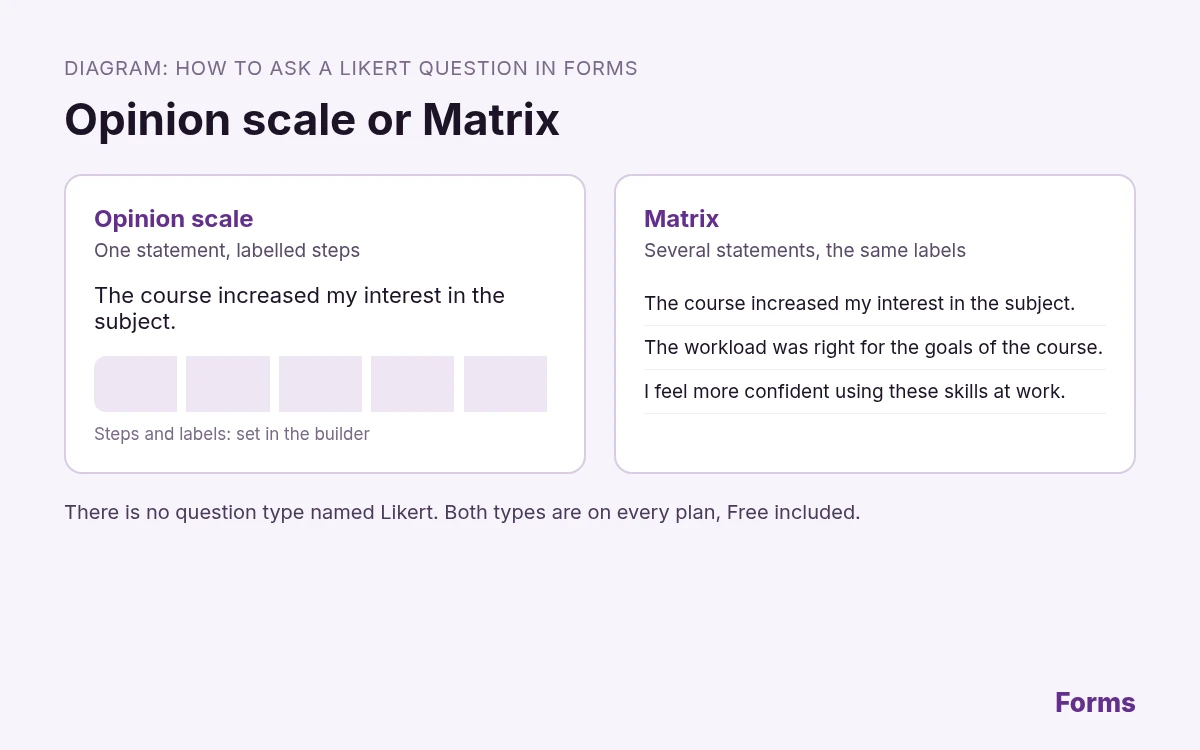
For a live form to start from, the course evaluation template has 7 questions and takes about 3 minutes, including its three Opinion scale statements. Browse more free form templates, or see types of questions in a questionnaire for the other formats.
All 25 question types are on every plan. Free gives you 3 active forms and 100 responses a month. Pro is $12/mo billed yearly. See Forms pricing.
Likert scale questions, answered
What is a Likert scale question?
A Likert scale question asks how strongly someone agrees with a statement, on labelled steps such as strongly disagree, disagree, neither disagree nor agree, agree and strongly agree. Strictly, one statement is a Likert-type item, and a Likert scale is a set of items whose ratings are summed into one attitude score.
What is an example of a Likert scale question?
"The course increased my interest in the subject," answered from strongly disagree to strongly agree, is a Likert-type item. It comes from the Forms course evaluation template, which asks it on an Opinion scale alongside two more statements. Several related statements like it, scored and summed, make a Likert scale.
How is a Likert scale different from a rating scale?
A Likert item measures agreement with a statement on labelled steps. A rating asks for a score on one thing, such as stars for an instructor, with no statement to agree with. In Forms, use an Opinion scale for a Likert-type item and Rating for stars or numbers. Neither Rating nor NPS is a Likert scale.
How many points should a Likert scale have?
Five points are common, according to the APA Dictionary of Psychology, and a neutral middle point may or may not be included. Likert's own 1932 survey used five: strongly approve, approve, undecided, disapprove and strongly disapprove. Include a neutral option when it is a real answer, and keep the steps in order.
Can I build a Likert question in Forms for free?
Yes. Forms has no question type named Likert, but the Opinion scale handles one agreement statement and the Matrix handles several statements on the same labels. Both are among the 25 question types on every plan. The Free plan includes 3 active forms and 100 responses a month. Pro is $12/mo billed yearly.
Start from the course evaluation template See Free vs Pro
New here? Start at Forms.