Multiple selection questions: examples, and when a yes/no is better
Some questions have more than one true answer. Someone may have contacted you by email and by chat in the same month. A multiple selection question tries to catch all of them in one list. This guide covers what it is, what Pew Research Center found when it tested that list against a simpler format, and how to ask it in Forms.
What a multiple selection question is
A multiple choice question asks for one answer. On the Forms page listing all 25 question types, Multiple choice is for "one answer from a short list".
A multiple selection question, also called select-all or check-all, lets the person choose more than one option from the same list. Pew describes the two ways to ask it plainly: show a list and ask people to select all that apply, or ask about each option separately.
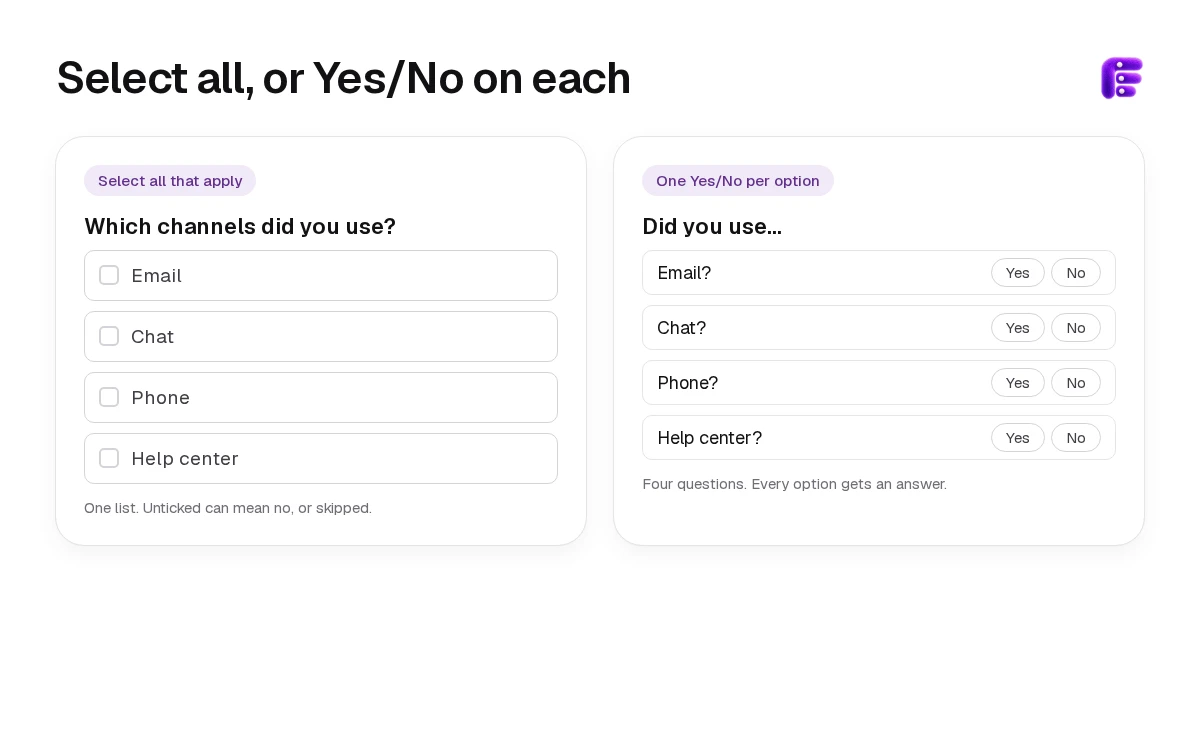
The two aren't interchangeable. Multiple choice gives you a single category. Multiple selection tries to record a set. Here is the same topic asked both ways:
- Multiple choice: "Which of these did you use most in the last month?" One answer.
- Multiple selection: "Which of these did you use in the last month? Select all that apply." Email, chat, phone, help center.
What Pew found when people only select some that apply
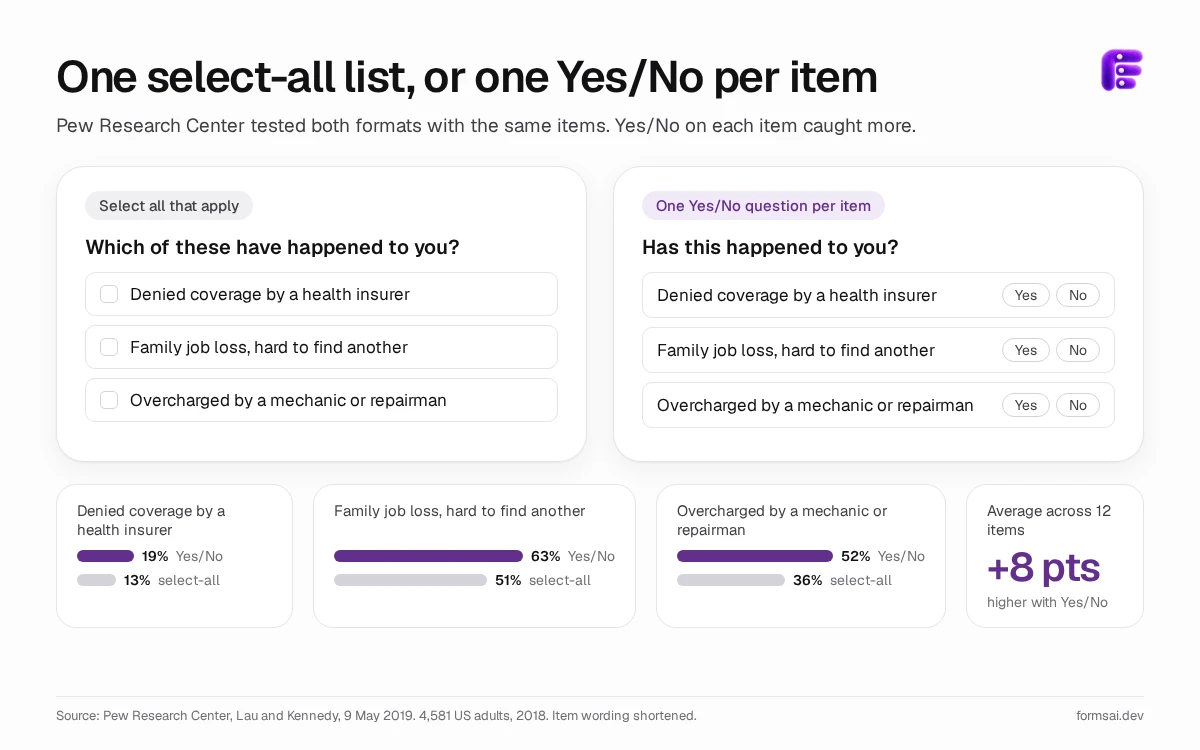
In a study published on 9 May 2019, Arnold Lau and Courtney Kennedy of Pew Research Center compared the two formats. The survey ran on Pew's American Trends Panel from 30 July to 12 August 2018, with 4,581 US adults. A random half saw a select-all list. The other half answered a yes/no for each item.
The items were undesirable events, such as being denied insurance coverage or losing a job. Pew treated higher reports as more accurate, because people are more likely to skip an event that really happened than to report one that didn't. The yes/no version caught more:
| Item | Yes/no on each item | Select all that apply |
|---|---|---|
| Personally denied coverage by a health insurance company | 19% | 13% |
| They or someone in their immediate family lost a job and struggled to find another | 63% | 51% |
| Personally overcharged by a mechanic or home repairman | 52% | 36% |
The mechanic item had the largest gap. Across all twelve items, the yes/no format ran 8 percentage points higher on average. After the study, Pew adopted a policy of using the yes/no format, which it calls forced choice, instead of select-all whenever possible.
The yes/no answers weren't bare. Pew gave them wording that matched the question: "Yes, has happened to me" and "No, has not happened to me". In your own form, you type the answer labels yourself.
One thing didn't change much: the rank order of the items was the same, or nearly so, in both formats. If you only need to know which item comes out on top, either format can do that job.
Format matters even more for vague questions. In an earlier Pew test, from 14 to 28 September 2017 with 4,867 US adults, "honor and duty are my core values" got 78% on forced choice and 44% on select-all, a 34-point gap. Pew points to survey research showing that vague, attitudinal items are more affected by question format than concrete, behavioral ones.
Order matters too. In a self-administered survey, people tend to pick options near the top of a list. Looking back across 21 of its surveys, Pew found an average order effect of 3 percentage points on select-all questions and 0 on forced-choice ones. It calls that archival comparison tentative, because the questions weren't tested head to head. Pew's guide to writing survey questions says the Center generally avoids select-all questions.
Examples, rewritten as yes/no
Each pair shows the select-all version, then the version to build.
1. Channels used last month
Checklist: email, chat, phone, help center.
Better: "In the last month, did you contact us by email?", then the same question for chat, phone and the help center. Yes or No for each.
2. Benefits enrolled in
Checklist: health, dental, retirement.
Better: one Yes/No per benefit, with the year in the question: "In 2026, are you enrolled in the health plan?", then the same for dental and retirement.
3. Event interests
Checklist: talks, workshop, dinner.
Better: "Will you attend the talks?", then the same shape for the workshop and the dinner. These are plans, not memories, so a checklist does less harm here. Separate questions still tell you who said no.
4. A sensitive experience
Checklist: don't use one.
Better: Pew's shape, one item at a time, with the answers "Yes, has happened to me" and "No, has not happened to me".
When a select-all list is still reasonable
If you only care about which item ranks first, the format barely changed the order in Pew's study, and a list is shorter: a yes/no for every option takes more screens. But a list isn't as accurate for the rates themselves. If you need to know how many people each option applies to, ask each one.
How to ask this in Forms
Forms does not document a select-all question type. Here is what each nearby type does:
- Multiple choice: one answer from a short list.
- Dropdown: a long list, still one answer.
- Picture choice: options shown as pictures.
- Checkbox: a consent tick, for things like safeguarding or data consent. Don't stack checkboxes into a select-all.
- Ranking: puts options in order. It isn't a set of yeses.
- Matrix: several items on one shared scale. It isn't documented as a check-all grid.
To build Pew's format, add a Yes/No question for each option. Yes/No is on every plan. If a Yes needs detail, show a follow-up with conditional logic, also on every plan: open the Logic tab, pick a condition and an action. A rule can combine up to 30 conditions.
The newsletter sign-up template asks which topics people want as Multiple choice, which records one answer. To learn every topic someone wants, ask a Yes/No about each one. For a template that already mixes a Yes/No with other types, see the employee pulse survey.
Results shows a chart for each question, so each Yes/No becomes its own share; see form analytics. Each Yes/No can also land in Google Sheets, on every plan.
A long run of Yes/No questions is still one form. Free gives you 3 active forms and 100 responses a month, and all 25 question types. If you'll pass 100 responses in a month, Pro is $12/mo billed yearly. The AI form builder is Pro only. See Forms pricing, or browse free form templates.
For the other types, see types of questions in a questionnaire, or dichotomous questions for more on the yes/no format itself.
Multiple selection questions, answered
What is a multiple selection question?
A multiple selection question lets the respondent choose every option that applies, often with the instruction "select all that apply". A multiple choice question asks for one option. Researchers also call the first kind a select-all or check-all question.
What is the difference between multiple choice and multiple selection?
Multiple choice records one category, such as the channel someone used most. Multiple selection tries to record a set, such as every channel they used. In Forms, Multiple choice is documented as one answer from a short list. A set of Yes/No questions is how you record the multiple-selection case.
Why do researchers avoid "select all that apply"?
People skip options that do apply. In a 2018 Pew Research Center experiment with 4,581 US adults, a yes/no on each item produced higher estimates than a select-all list. Denied insurance coverage was 19% versus 13%. A job loss in the family was 63% versus 51%. The average gap was 8 percentage points. Pew now uses the yes/no format whenever it can. The rank order of items was usually the same, so a list is enough if you only need a ranking.
How do I ask a multiple selection question in Forms?
Forms does not document a select-all question type. Add a Yes/No question for each option, and put the time period in the question. Checkbox is for consent, not for ticking many options. Conditional logic can open a follow-up when the answer is Yes. Yes/No and logic are on every plan, including Free.
Can people pick more than one answer on a multiple choice question in Forms?
Not according to the public question-types page. Multiple choice is for one answer from a short list. A searchable dropdown is for one answer from a long list. If you need more than one, ask a separate Yes/No for each option.
Start from the employee pulse survey See Free vs Pro
New here? Start at Forms.