Questions
Age, income and education questions for a survey
Age, income and education are the demographic questions most surveys ask. This guide gives the US Census wording for each, where to put them, and the Forms question type that fits. Ask them only if you'll use the answers.
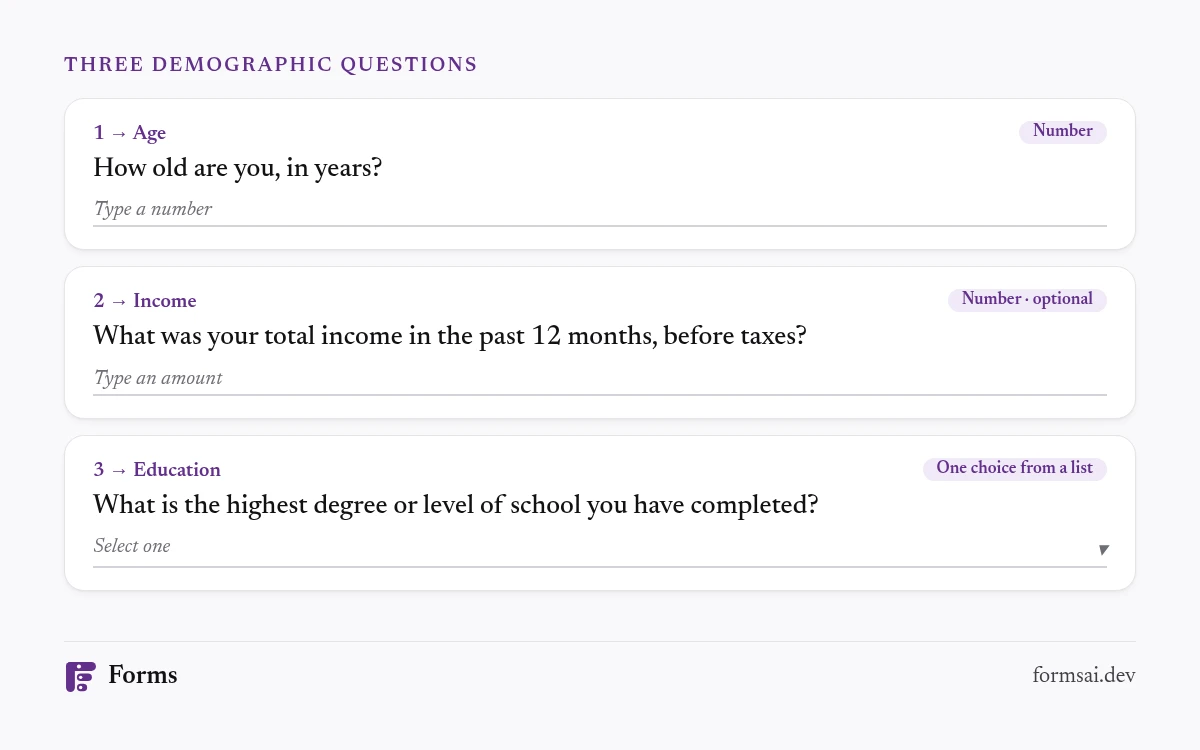
Where to put them
Pew Research Center's guide to writing survey questions advises against asking demographic questions such as income, education or age near the beginning of a survey, unless you need them to decide who is eligible or where to route people.
The customer needs survey is a live form that asks age first. If you start from it, move the age question later unless it decides who continues. Its own tip is to keep age as ranges because people answer ranges more readily. That's the template's advice, not a research finding.
How to ask age
The US Census Bureau's American Community Survey asks: "What is your age and what is your date of birth?" Its 2026 group-quarters questionnaire adds: "For babies less than 1 year old, do not write the age in months. Write 0 as the age."
In Forms, pick one of three ways, not all three:
- Age in years: a Number question, with a range set so the answer stays within bounds you choose. This is one of the quantitative questions you can calculate with.
- Date of birth: a Date question. You'll work out age from it yourself.
- Age bands: a Multiple choice question with bands you write yourself. There's no official band list, so make the bands cover every age you expect without overlapping. A band question is one of the closed-ended questions.
How to ask income
The American Community Survey asks about income by source. Question 43, "Income in the past 12 months", asks for the total amount of each type of income over the past 12 months. Its wage line asks for "the amount from all jobs before deductions for taxes, bonds, dues, or other items". Question 44 then asks for total income during the past 12 months, adding the sources together.
So the Census asks for dollar amounts, not bands. For a one-question version in Forms, use a Number question that says whether you want total income or one source, names the past 12 months, and asks for the amount before taxes. Make it optional rather than required.
If you'd rather use income bands, write your own Multiple choice ranges. They're your bands, so label them that way when you report the results.
How to ask education level
The American Community Survey asks: "What is the highest grade of school or degree you have COMPLETED? Mark (X) ONE box. If currently enrolled, select the previous grade or highest degree received." Its 12 answers are:
- Less than grade 1
- Grade 1 through 11
- 12th grade, no diploma
- Regular high school diploma
- GED or alternative credential
- Some college credit, but less than 1 year of college credit
- 1 or more years of college credit, no degree
- Associate's degree
- Bachelor's degree
- Master's degree
- Professional degree beyond a bachelor's degree
- Doctorate degree
In Forms, put these in a Dropdown. A shorter Multiple choice list is fine if you say the bands are your own. The list follows US schooling. The Census help page tells people to report schooling completed in foreign or ungraded schools as the equivalent level in the regular American school system.
Privacy, briefly
Answers to a form belong to the form's owner, and Forms processes them on the owner's behalf, as the privacy policy sets out. Each response also records the respondent's device type, country (from their connection) and a random visitor ID.
If you tell people their answers won't be tied to their name, don't ask for a name or email on the same form. Age, income and education together can point to one person in a small group, so take care when you report small groups.
Build it in Forms
Number, Date, Multiple choice and Dropdown are among all 25 question types, and every type is on every plan. There's no question type named Demographic. These four cover age, income and education.
If you're adding these questions to a workplace survey such as the employee pulse survey, put them after its main questions.
Free gives you 3 active forms and 100 responses a month. Pro is $12/mo billed yearly. See Forms pricing, or types of questions in a questionnaire for the other formats.
Demographic questions, answered
How should I ask age on a survey?
Ask it after your main questions unless it decides who continues. Use one format: a Number question for age in years, a Date question for date of birth, or Multiple choice bands you write yourself. The US Census American Community Survey asks for both age in years and date of birth.
Should age be a number or a range?
A number in years keeps the most detail, and you can group it into ranges later. Ranges you write yourself can be quicker to pick from, but you can't split them afterwards. There is no official list of age bands, so make yours cover every age you expect without overlapping.
How do I ask income on a survey?
Ask for a dollar amount over a named period, and say whether you mean total income or one source. The US Census American Community Survey asks income by source for the past 12 months, then a total. In Forms, use an optional Number question that names the past 12 months and says before taxes.
What education levels should a survey use?
For US respondents, the American Community Survey's 12 categories are a good model, from less than grade 1 to a doctorate degree, asking for the highest grade or degree completed. Put them in a Dropdown. A shorter list is fine if you label the bands as your own. The Census asks people schooled abroad to report the US equivalent.
Are demographic questions free in Forms?
Yes. Forms has no question type named Demographic, but Number, Date, Multiple choice and Dropdown cover age, income and education, and all of them are among the 25 question types on every plan, Free included. Free is 3 active forms and 100 responses a month. Pro is $12/mo billed yearly.
Start from the customer needs survey See Free vs Pro
New here? Start at Forms.